
How to Layoff-Proof Your Startup Job in the AI Era
Apr 25, 2026The people who get laid off at a startup aren't the ones who lost to AI. They're the ones the founders couldn't see.
If you want to layoff-proof your startup job in the AI era, the first thing to know is that the standard advice is built for a company you don't work at. Build new skills. Get an AI certification. Diversify your network. All fine. None of it is what gets you on the keep list at a startup where the founders are writing the cut list on a Sunday night and they know your name.
I've watched a lot of layoffs from the inside. Over 20 years in startups, I've sat in the room when the cut list got drawn. I've been on the wrong end of it twice. Good times.
I've seen who survives and who doesn't. The pattern almost never matches the explanation HR gives at the all-hands.
Here is a scene I've replayed a hundred times. Series A startup, runway tight. The founder writes the cut list at their kitchen table on a Sunday. They have to drop three. The first name they put down is the senior engineer running point on integrations. Brilliant person. They couldn't think of a single shipped thing from them in the last six weeks. The junior PM, two months in, survives. They remembered them ending every Slack update with "shipped today" and a screenshot. The engineer was technically better at the job. The PM was visible. Sight decided who walked.
In 2026, the layoffs keep getting blamed on AI. Over 92,000 tech jobs gone in the first four months alone, according to Layoffs.fyi. Meta cutting 10%. Microsoft, Snap, and Nike all swinging in April. Every founder pitch deck now has a slide about "AI-driven leverage," with the polite implication that some of you cost too much for what the model can do for free.
That story is mostly cover. I wrote about why in the AI-washing post. The deeper truth is that at a startup, the layoff math has never really been about AI. It's about who the founders mentally cannot afford to lose.
This post is the playbook for being on the keep list. Built from inside startups of every size and stage, where cut decisions are personal, the people deciding know your output, and your equity is on the same line as your salary.
One thing to be CRYSTAL clear about. This IS NOT playbook for looking busy. It's for the people doing great work and watching it disappear into a void. If the work itself is average, putting it in front of the founders won't save you. It'll just confirm what they already think. The moves below assume you're doing the work. Visibility is how good gets noticed. It's not a substitute for being good.
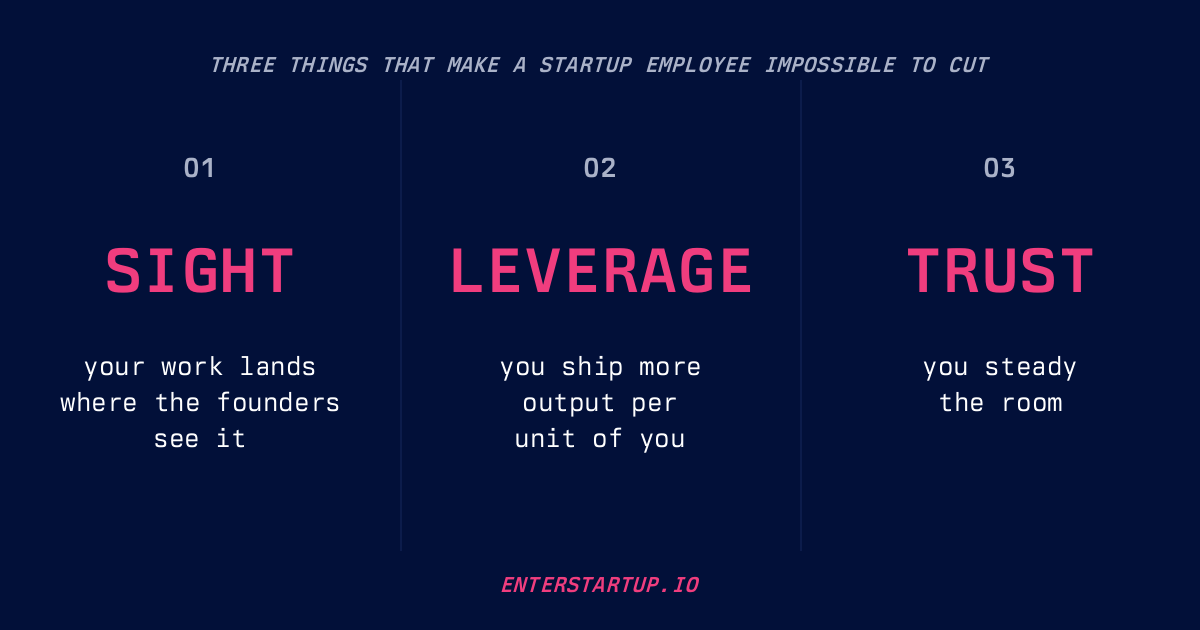
The short version. Three things make a startup employee impossible to cut: sight, leverage, and trust. Sight means your work lands where the founders see it. Leverage means you ship more output per unit of you, with AI tools and across functions. Trust means the team and the founders feel safer with you in the room. Get those three right and the AI conversation stops being about you.
What does it mean to layoff-proof your startup job?
Layoff-proofing your startup job means becoming the employee the founders mentally cannot afford to cut. The point is to make sure that when they walk through the org chart and ask who could go, your name is the one they skip past. Three things produce that mental skip: sight, leverage, and trust. None of them are job titles or credentials. They're states you produce by what you ship and how you carry it.
Job security is a corporate concept. It implies an HR policy, a tenure system, a process. None of those things really exist (at least "properly") at a startup. The decision to cut you takes 15 minutes in a Friday meeting, and the rule of thumb is "can we run the company without this person."
So the action verb here isn't "protect." It's "produce." You produce sight, you produce leverage, and you produce trust. The mental skip is the result.
Why is layoff-proofing different at a startup than at a big company?
Layoff-proofing at a startup is different because cut decisions are made fast, personally, by founders who know your name and your output. The protections that exist at a big company (tenure, job code, HR process) are absent here. What protects you instead is whether the founders can mentally picture the company without you in it. Get that picture wrong and your salary line is the next one to go.
At a Fortune 500, layoffs are a process. Headcount targets cascade down. HR runs comp packages. Managers fill out forms. By the time the decision reaches you, it's been through six steps and a dozen committee meetings, and a lot of your protection comes from tenure, job code, and how visible the cut would be to legal. The "job hugging" trend Korn Ferry named in 2025 is the corporate version of this: employees clinging to the protection of process.
At a startup, the founders write the list on a Sunday night. They know who you are. They know whether you shipped anything in the last two weeks. They know whether the team complains about you or asks for you. They're also under board pressure, watching their own runway, and weighing whether your salary is better spent on three months of ad budget or one senior hire who can do two jobs.
That changes everything about what protects you. Tenure doesn't matter. Job description doesn't matter. The credentials on your LinkedIn don't matter. What matters is whether the founders can picture the company three months from now with you still in it.
You also have a second wrinkle a corporate employee doesn't. Your equity. Most of it isn't vested yet. If you get cut, you walk away from a percentage of the upside you already paid for in late nights and weekend syncs. The cost of being on the cut list is your salary plus the "equity lottery ticket" (as I call it, based on the % likelihood you'll get any significant paylout!). That math cuts against you.
If the anxiety is already loud in your head, you're not crazy. HBR's research on layoff anxiety shows it's a rational response to a bad signal environment, not paranoia. The mistake is letting that anxiety pull you into doom-scrolling Layoffs.fyi instead of into the moves below.
How do you make yourself indispensable at a startup?
Three things make a startup employee indispensable: sight, leverage, and trust. Sight means the founders see what you ship, where they read, in language they can re-tell to the board. Leverage means you produce more output per unit of you, with AI tools and by ranging across functions. Trust means the team and the founders feel safer with you in the room. The other framing on the SERP (skills, certifications, side projects) is downstream of these three.
Sight doesn't rescue bad work. It exposes it.
Sight
Sight is the foundation. If the founders don't see your work, your work didn't happen. Not in the way that counts.
This isn't about face time. It's about output that lands in places the founders read. Slack channels they check. Demos they attend. Customer calls they're on. Metrics dashboards they refresh on Sunday night. Brilliant work in a Notion page no one opens is a gift to the cut list.
The strongest form of sight is the one with a dollar sign on it. You touch money, or you touch the thing that brings money in. Sales obviously. Customer success often. Product, when product is shipping things customers pay for. Marketing, when marketing is generating pipeline you can attribute. Engineering, when engineering is a quarter ahead of the customer ask. Every other function is structurally further from the line. That's not personal. It's just the math of how a startup with tight runway allocates its spend.
You can't always pick your function. You can always frame your work in revenue terms. The internal tool you built saved 15 sales rep hours per week. The onboarding doc you wrote shaved two days off time-to-first-deal. The bug you fixed unblocked the renewal. Make the math explicit, in writing, when it lands.
Leverage
Leverage is producing more output per unit of you. Two flavors at a startup. AI leverage and cross-functional leverage. Both compound.
AI leverage is the obvious one in 2026. The founders are reading the same X/Twitter you are. They've seen the demos where one engineer with Cursor and Claude Code does the work of three. The story they're being sold is that AI replaces people. The story they're actually buying is that AI multiplies people. You want to be the multiplied. Use the tools, ship the leveraged output, and tell the founders explicitly what the leverage is. "Used AI to draft this in 20 minutes instead of two days, spent the saved time on the customer interviews you asked for." That sentence is layoff-proofing in real time. If you want the longer playbook, I broke down the workflows in How to Use AI at a Startup.
Cross-functional leverage is the quieter version. At most startups, half the work doesn't have a clean owner. The person who can pick up the unowned thing and drag it across the line is structurally hard to cut, because cutting them creates a pile of new work no one else can hold. This isn't about being a generalist. It's about being a closer. You have a specialty, you do it well, and you also pick up the in-between work that's drifting. The customer onboarding flow that's half product, half success, half nobody. The new sales hire's first 30 days. The pricing page that hasn't been touched in a year.
The founders remember you for the closing, not the specialty.
Trust
Trust is the quietest pillar and the most underrated. There are people on every team whose presence makes the rest of the team work better. They're the ones the founders hear in 1:1s when others say "I want to keep working here because of so-and-so."
It's 11pm on a Tuesday. A customer escalation lands in the team Slack channel. The trusted person acknowledges it inside a minute, DMs the customer success lead, and posts one line back to the channel: "I've got it, replying tonight, will recap tomorrow." No drama. No sirens. The founders sleep through it. Doing that once doesn't earn trust. Doing it for six months without making it a thing does.
You don't have to be charismatic. You have to be steady. You don't add to the founders' stress. You don't create drama in Slack. You don't bring complaints up without bringing solutions. You back the team's hard decisions in front of customers. You're a reliable signal of the company's health to the rest of the team.
When the cut list gets drawn, trusted people get protected because losing them creates a second-order morale problem the founders don't want to manage on top of everything else.
What are the biggest mistakes that get startup employees laid off?
The three mistakes that put startup employees on the cut list are invisible work, narrow specialization, and AI theatre. Each one looks fine from the inside and damaging from the founders' seat. The fix for each is the inverse: make the work visible, range across functions, and ship leveraged output instead of talking about it.
-
Invisible work. You ship great stuff but tag it as "small fix" in the PR. You write internal docs that solve real problems but don't share them. You handle a customer escalation but don't loop the founders in. The work happened. In their heads, nothing did.
Instead, do this. Write a Friday update. Five sentences. What shipped, what it unlocked, what's next. Land it in the channel the founders read. The point isn't bragging. It's mental indexing. You're putting your work into their memory so it shows up when they're drawing the org chart.
-
Narrow specialization. You're the database person. The frontend person. The sales ops person. You do your job extremely well, and only your job. When the founders think about cutting headcount, you're a single line item with a clean swap-out for a contractor or an AI tool.
Instead, do this. Pick one adjacent function and start ranging into it. Pair with the person who owns it. Help on the work that crosses the seam between you. You don't need to become an expert in the new function. You need to become the person whose absence creates a coordination headache no one wants.
-
AI theatre. You talk about AI in standups. You forwarded the latest Anthropic announcement to the team. You have ChatGPT open in another tab. Your actual output hasn't changed. The founders can tell the difference between people who post about AI and people who ship leveraged work, even if they don't say it out loud.
Instead, do this. Pick one workflow this week that's eating your time. Build an AI-leveraged version. Ship it. Share the before-and-after with the team. Repeat next week. The proof is in the leveraged output, not the language.
How do you start layoff-proofing your startup job tomorrow?
You can start layoff-proofing your startup job this week. Five moves: claim one revenue line on the team's roadmap, send a five-sentence Friday update where the founders read, ship one AI-leveraged workflow by week's end, take ownership of one piece of unowned work, and build one outside relationship before the month is out. None of these need permission.
-
Claim one revenue line on the team's roadmap. Pick a number that matters. ARR. Conversion. Retention. New logos. Pipeline. Put your name on it (in your head first, then in your next 1:1 with your manager). For two weeks, your only job is making that number move. Tell the founders when it does.
-
Send a five-sentence Friday update to the channel the founders read. What shipped, what it unlocked, what's next. No formatting. No preamble. No asks. The point is mental indexing. You're putting your name and your work into the founders' memory so they show up together when the cut list gets drawn.
-
Ship one AI-leveraged workflow by Friday. Pick something repetitive. The customer follow-up email. The standup summary. The onboarding doc. Build the AI version. Use it once. Share the before-and-after with the team in one sentence.
-
Claim one piece of unowned work. Look at the team's work right now and find the thing nobody is holding. Pick it up. Put a one-line update in the channel the founders read that says "I'm taking this." Run it for two weeks. By week three, it's yours, and removing you means removing the work.
-
Build one outside relationship per month. Not job hunting. Optionality. One coffee, one call, one DM with a recruiter or peer at another startup, every month. The founders who lay off the most aggressively are also the ones who send the most desperate "anyone you'd recommend" emails. You want to be in those inboxes if your seat goes.
This isn't theory. It's what people who survive startup cuts actually do. None of it requires permission. Most of it doesn't even require a conversation with your manager beyond the Friday update.
If you're already past this point and the layoff has happened, the playbook shifts to triage. I covered that in How to Survive a Startup Layoff.
The cut list at a startup isn't long. It's three to five names, picked in 48 hours, by people who know you. The work between now and the next cut is making sure your name doesn't get written down. That's what it actually means to layoff-proof your startup job in the AI era. Not protection. Production. Sight, leverage, and trust.
If you want the framework that sits underneath all of this, I wrote about it in the ARC Relationships post. The relationship side is half of what makes a startup employee impossible to cut.
If you want to go deeper, I work with people directly through 1:1 coaching.
And if you're at a startup right now and want a working playbook for the rest of the role, the free Enter Startup course is the place to start.
The people who get laid off at a startup aren't the ones who lost to AI. They're the ones the founders couldn't see. Make sure they can see you.