
AI Layoffs 2026: Most Are Corporate Cover (Here's What to Do)
Feb 18, 202655,000 people were told AI took their jobs last year
Some of those people are sitting where you're sitting right now. Scrolling through headlines. Wondering "will AI take my job?"
That knot in your stomach that won't quite go away.
I get it. I've spent nearly 20 years inside startups. I've been on the wrong end of layoffs myself. I know exactly what it feels like when the ground shifts under you and nobody hands you a map.
The scariest moments aren't when you lose your job. They're when you realize the old rules don't work anymore.
And right now, a lot of rules are breaking.
So let me walk you through what's actually happening with AI and jobs. Not the clickbait. Not the hype. The real picture, backed by data from Harvard, Stanford, Goldman Sachs, the World Economic Forum, and more. Then I'll tell you about the career move most people are completely overlooking. (Hint: it's not "just learn AI.")
Is AI Actually Replacing Jobs Right Now?
The short answer: yes, but not the way most headlines suggest. Around 55,000 U.S. jobs were blamed on AI in 2025. That's only 4.5% of total layoffs. Harvard Business Review found most AI layoffs were based on what AI might do, not what it's actually doing. The real damage so far is concentrated in entry-level roles, freelance work, and a handful of specific industries (as of today).
Let's start with what we know for certain. Most of the hard data comes from the U.S. because that's where the best tracking exists, but the patterns are playing out globally.
Challenger, Gray & Christmas, the firm that's tracked U.S. layoffs for decades, reported that employers attributed 54,836 job cuts directly to AI in 2025. That's a real number. It's 12 times higher than when they started tracking AI-related cuts in 2023.
Sounds terrifying, right?
But context matters. Those 55,000 AI-attributed cuts were just 4.5% of the 1.2 million total layoffs that year. Government restructuring alone accounted for nearly 300,000. Economic conditions drove another 250,000. Store closures wiped out close to 200,000.
AI was a factor. But it wasn't THE factor.
The World Economic Forum surveyed over 1,000 companies across 55 countries and projected that by 2030, AI and automation will create 170 million new jobs while displacing 92 million. That's a net gain of 78 million jobs globally.
Goldman Sachs looked at the U.S. specifically and estimated that only 2.5% of jobs face any real risk of being replaced soon. Their AI Adoption Tracker found that just 9% of companies are actually using AI in production.
Nine percent. Not ninety.
So where does the fear come from? Partly from how exposed we all feel, and the thread of 'general intelligence' and what that may or may not mean.
The IMF put a wider lens on it. About 40% of global employment is "exposed" to AI. In advanced economies like the UK, U.S., and across Europe, that rises to 60%.
But "exposed" doesn't mean "replaced." It means AI can handle some of the tasks in those jobs. And roughly half of those workers might actually benefit from AI making their roles more productive, not less.
So if you've been reading headlines that make it sound like the machines have already won? Take a breath. The overall numbers don't support that. Not just yet anyway.
But if you're already thinking about a career change because of AI? You're not being paranoid. You might just be early. Here's why.
The Biggest Lie in Business Right Now
There's a term gaining traction in boardrooms, newsrooms, and research papers: AI-washing.
It works like this. A company needs to cut costs. Maybe they over-hired during the pandemic boom. Maybe their business model is struggling. Maybe they're facing pressure from tariffs or a shifting market. Instead of saying any of that, they announce they're "investing in AI transformation" and cutting headcount to match.
Wall Street loves it. Share price holds steady or goes up. The narrative sounds forward-thinking instead of desperate.
Harvard Business Review published a study in January 2026. They surveyed over 1,000 global executives. Here's what came back.
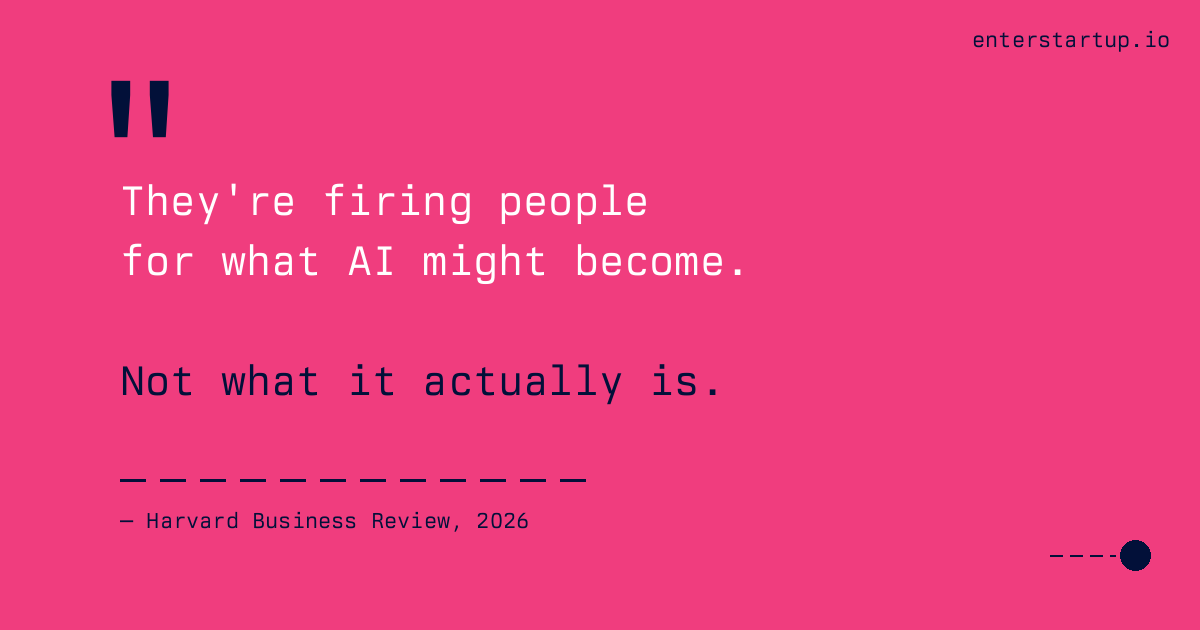
Most AI-related layoffs were made in anticipation of what AI might do in the future. Not because of what it's doing right now. Over 600 executives admitted they were cutting jobs based on AI's potential, not its performance.
Read that again. They're firing people for what AI might become. Not what it actually is.
A Wharton professor named Peter Cappelli put it bluntly. The headlines say it's because of AI. But if you read what these companies actually say, they're hoping AI will cover the work. They haven't proven it. They're saying it because that's what investors want to hear.
Oxford Economics backed this up. Their analysis found that if AI were genuinely replacing workers left and right, productivity should be going up. Instead, it's actually slowed down. Their conclusion? Some companies are dressing up layoffs as a good news story instead of a bad one.
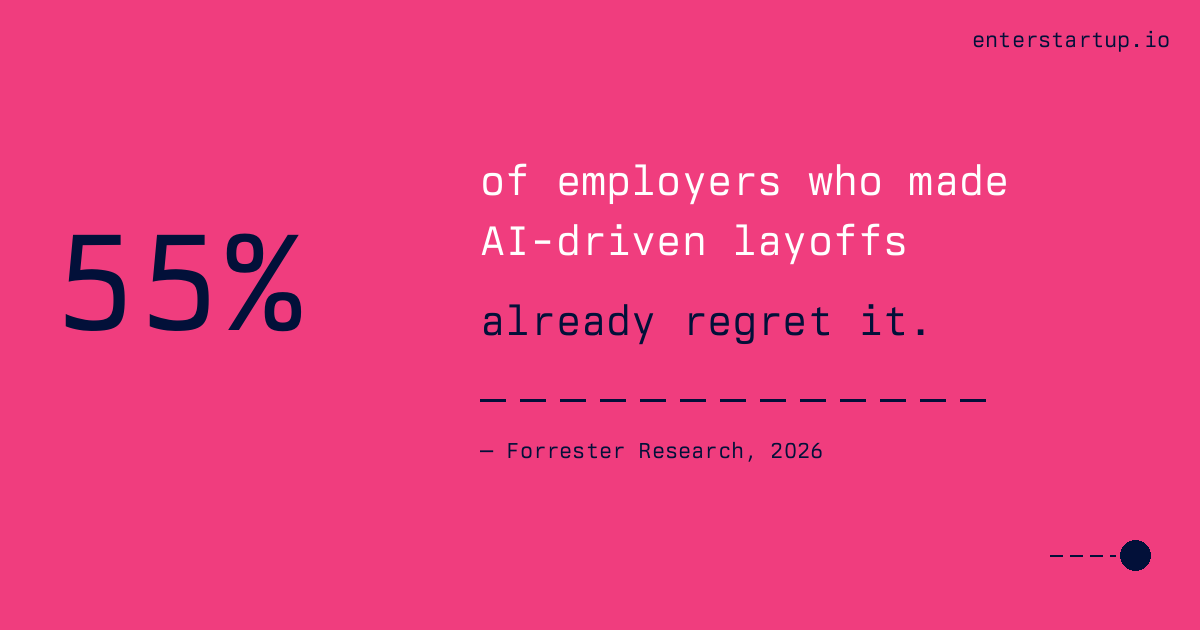
Forrester Research went further. Their 2026 predictions report estimated that 55% of employers who made AI-driven layoffs already regret it. And half of those cuts will be quietly rehired, often offshore or at lower salaries.
Klarna is the poster child for how this goes wrong. They slashed their workforce from 5,000 to 3,000 employees, with their CEO proudly claiming AI had replaced 700 customer service agents. The press loved it. Then quality tanked. Customer complaints surged. And Klarna started quietly rehiring the humans they'd just let go. You couldn't make it up.
AI-washing is real. And if you're anxious about your job because of an announcement your company made, it's worth asking: is AI actually doing the work, or is it just the excuse?
Where AI Job Losses Are Actually Happening
Despite the AI-washing, real signals are stacking up. And they're hitting specific groups hard.
The people getting hurt first aren't senior leaders or experienced operators. They're the youngest workers in the room. And it's spreading. White-collar professionals are watching AI layoffs creep closer to their desks too.
Stanford's Digital Economy Lab analyzed payroll data covering millions of U.S. workers. People aged 22 to 25 in AI-exposed jobs (software engineering, customer service, accounting) saw a 16% relative drop in employment since late 2022. Meanwhile, workers over 30 in the exact same roles saw their employment grow.
Entry-level job postings have plunged 35% since January 2023. New graduate hiring at the biggest tech companies dropped 50% over five years. Only 30% of 2025 graduates found full-time work in their field by July. That's not a stat. That's a generation hitting a wall.
And if you're a freelancer? The data is brutal. Translator earnings dropped 30% after ChatGPT launched. Writing jobs on Upwork fell by a third. One copywriting agency went from $600,000 in annual revenue to under $10,000 in a single year.
Some entire business models have simply collapsed. Chegg, the homework help company, lost 99% of its stock value as students switched to ChatGPT. Stack Overflow's monthly question volume dropped from 200,000 to under 4,000. The stock photography industry was forced into a merger worth $3.7 billion because AI-generated images ate their market alive.
These aren't projections. These are things that have already happened.
So no, AI hasn't destroyed the overall job market. But it has obliterated specific corners of it. Look at the jobs replaced by AI so far and the thread is obvious: routine, screen-based, not much human judgment required. If that sounds like your work, the pressure is already on.
AI Job Market Predictions for 2026
I'm not going to sugarcoat this. The signals for the rest of 2026 say things are speeding up, not slowing down.
McKinsey's data shows 32% of companies expect to reduce their workforce in the coming year because of AI. Goldman Sachs analysts expect AI adoption to jump from 9% to around 50% within a year. Sapphire Ventures and Battery Ventures are calling 2026 "the year of agents," where AI moves from making people more productive to automating the work itself.
Amazon's own internal documents, leaked to the New York Times, revealed plans to automate 75% of their operations by 2033 and avoid hiring 600,000 workers. They already have more robots in their warehouses than humans. Waymo is doing 450,000 autonomous rides per week. Driverless trucks are running commercial routes across Texas and Arizona.
Gartner predicts one in five organizations will use AI to flatten their hierarchy and eliminate over half their middle management positions by end of 2026.
But here's the thing. Yale, the NBER, and the Dallas Fed have all looked at this closely. They all say the same thing: the overall job market isn't collapsing. Not yet. The shift is happening, and it's very real. BUT... it's hitting in pockets, not across the board.
The future of work isn't a cliff. It's a slope. Getting steeper. With specific groups sliding first while the headline numbers look fine.
If you're in one of those groups, "the overall numbers look fine" is cold comfort.
So what do you do?
The Reskilling Myth Everyone's Selling You
Here's the part that really frustrates me.
Every article about AI and jobs ends the same way. "Just upskill." "Learn new tools." "Get AI-literate." As if the solution to everything I just described is a weekend course on prompt engineering.
The World Economic Forum says 59 out of every 100 workers will need retraining by 2030. 85% of employers say upskilling is a top priority. 89% of executives say their workforce needs better AI skills.
Sounds like everyone's on it, right?
Wrong.
Only 6% of companies have actually started meaningful upskilling programs. Six percent. That's the gap between what companies say and what they do. And that gap has a price tag. IDC estimates it could cost the global economy $5.5 trillion in lost performance by the end of the decade.
Meanwhile, workers with AI skills earn a 56% wage premium over comparable roles. In the U.S., the median salary for AI positions sits around $157,000. In the UK and Europe, the premium is similar in percentage terms even if the absolute numbers differ. The incentive to reskill is massive. But the support to do it? Almost nonexistent.
Think about what that means. The world is telling workers to adapt. Companies aren't investing in helping them adapt. And the people who figure it out on their own? Getting paid a fortune.
That gap between "figure it out yourself" and "we'll pay you a fortune if you do" tells you everything about where the opportunities are.
Because that gap? That's exactly how startups work.
Startup Careers: The Path Nobody's Really Talking About
Most of the advice out there falls into two buckets. Either "the robots are coming, run" or "just learn AI and you'll be fine." Both miss the point completely.
Let me tell you what I've actually seen work. I've been in multiple startups across the UK, US, and APAC. Helping founders in over $125 million in combined exits. I've watched people thrive in chaos and I've watched equally talented people get destroyed by it. The difference always comes down to the same thing.
Christmas, years ago. My team had just pulled a 48-hour sprint to nail a prototype before a board meeting. Two all-nighters back-to-back. Caffeine and adrenaline. We nailed it. The board was impressed.
Two days later, everyone got fired. The whole team. Same skills. Same experience level. But what happened next was completely different.
One designer, brilliant portfolio, incredible talent, spent months bitter about it. Couldn't move on. Kept talking about the project that got killed. Another guy, a senior engineer who always grabbed everyone's lunch orders, stayed late to help people, fixed things without being asked? He was hired within a week. He eventually went on to run his own company.
Same disaster. Completely different outcomes.
The difference wasn't talent. It was what I now call ARC. Attitude, Relationships, Competence.
Attitude is how you respond to chaos. Can you burn the luggage and move to the next thing? AI doesn't have attitude. It doesn't have agency. When the plan falls apart, it just sits there. You get to decide what happens next. That's irreplaceable.
Relationships are your career insurance policy. AI can process data all day long, but it can't walk into a room and make someone feel heard. Every single time I've seen someone bounce back from getting fired, it was relationships that caught them. Not job boards. Not LinkedIn. People who already trusted them.
Competence goes way beyond skill. It's shipping work that matters when nobody told you what to build. Execution without instructions. AI is a powerful tool, no question. But someone still has to point it at the right problem, interpret what comes back, and make the call. That someone is you.
When all three work together, they create compound trust.
Your attitude makes people want to work with you. Your relationships make people think of you first. Your competence makes people depend on you.
Stack all three, even for 18 months, and you become professionally unfireable. Not at one company. That's impossible. But from the entire ecosystem. Someone, somewhere, always needs someone with proven ARC.
Where does this matter most? Somewhere chaotic, ambiguous, where you have to figure it out yourself or die trying.
Startups.
I know. Startups? In this economy? And yes, 90% of startups fail.
But think about it. While big corporations are laying people off and calling it AI transformation, startups are building the actual future. They need humans who can operate without instructions, make decisions when the data is incomplete, and bring judgment that no model can replicate. And the people who learn to thrive inside that chaos? They become the 10% who win. Even when a startup doesn't make it, what you learned and who you met goes with you.
ARC works everywhere. In a corporate role. In a freelance career. In whatever you do next.
But startups are where it compounds fastest.
In a corporation, your ARC might get you promoted eventually. In a startup, it determines whether you survive your first three weeks. The feedback loop is immediate. The learning curve is vertical. And everything you build carries over to whatever comes next.
Here's what most career advice gets wrong: there's no such thing as an AI-proof job. Tools change. Industries shift. But you can make yourself AI-proof. Adaptability. Resilience. Creative problem-solving. Trust-building. No algorithm replicates those. And startups are where you develop them at ten times the speed.
AI changes what tools you use. It doesn't change what makes you valuable as a human.
How to Protect Your Career from AI Starting Today
You don't have to quit your job tomorrow. But you can start building your ARC today, wherever you are.
Start with attitude. Next time something breaks at work, try to fix it before asking for help. When plans change, write down what you'll learn from the new direction. Practice defaulting to action over paralysis, solutions over problems. Every time you choose agency over paralysis, you're literally rewiring your brain. Deliberate practice does that. The neural pathways get stronger each time.
Invest in relationships. Reach out to three people in your network this week. Not to ask for anything. To offer something. Share a resource. Make an introduction. The people who survive disruption are the ones who built their network before they needed it.
Make your competence visible. Ship something small. Write about something you learned. Build something useful and put it where people can see it. Between jobs doesn't mean between contributions. Your value isn't your title. It's what you create.
Get curious about startups. Talk to people who work in them. Ask what the first month was really like. Read books by people who've actually been in the trenches, not just the founders. If you want a place to start, I put together a list of the 7 best startup books that actually prepare you for the reality. The culture shock coming from corporate is real. But the growth is unlike anything else.
None of this requires permission. None of it requires a new job. Get at it.
And if you want the full system?
A Human Operating System for an AI World
I wrote a book about exactly this. It's called Enter Startup: The Employee's Guide to Getting Hired, Shipping Fast & Thriving When Everything's on Fire.
Not for founders. There are plenty of books for founders. This one is for the people actually building the products, closing the deals, and doing the work. The employees.
100+ research citations from neuroscience and behavioral science. Because understanding what's happening in your brain matters as much as understanding what's happening in the market.
Sitting in a corporate job wondering whether AI is coming for your role? This gives you a framework that works regardless of what technology does next.
Already been hit? Between jobs right now, staring at a market that feels like it's closing doors? This is especially for you. The framework doesn't require a title or a company. It requires you.
Technologies change. The human operating system that makes you indispensable? That stays.
Get first access to Enter Startup →
Your ARC is yours. It compounds. It transfers. And unlike equity, it always vests.
Go build something that matters.
Research for this article was performed by Claude Opus 4.6 across 700+ sources to surface data, verify claims, and generate citations. Analysis, editorial judgment, and writing by Greg Taylor with Opus as co-pilot. The human, me, decided what matters. The AI helped prove it.
Sources & References
The data and research cited throughout this article draws from the following institutional sources, academic studies, and investigative reports. Listed in order of appearance:
-
Challenger, Gray & Christmas – "2025 Year-End Challenger Report: Highest Q4 Layoffs Since 2008; Lowest YTD Hiring Since 2010" (January 8, 2026) — https://www.challengergray.com/blog/2025-year-end-challenger-report-highest-q4-layoffs-since-2008-lowest-ytd-hiring-since-2010/
-
World Economic Forum – "Future of Jobs Report 2025" (January 8, 2025) — https://www.weforum.org/publications/the-future-of-jobs-report-2025/
-
Goldman Sachs Research – "How Will AI Affect the Global Workforce?" (Joseph Briggs and Sarah Dong, August 13, 2025) — https://www.goldmansachs.com/insights/articles/how-will-ai-affect-the-global-workforce
-
Harvard Business Review – "Companies Are Laying Off Workers Because of AI's Potential—Not Its Performance" (Thomas Davenport and Laks Srinivasan, January 29, 2026) — https://hbr.org/2026/01/companies-are-laying-off-workers-because-of-ais-potential-not-its-performance
-
Oxford Economics – "Evidence of an AI-Driven Shakeup of Job Markets Is Patchy" (Ben May, August 2025) — https://www.oxfordeconomics.com/resource/evidence-of-an-ai-driven-shakeup-of-job-markets-is-patchy/
-
Forrester Research – "Predictions 2026: The Future of Work" (January 2026) — https://hrexecutive.com/the-ai-layoff-trap-why-half-will-be-quietly-rehired/
-
Stanford Digital Economy Lab – "Canaries in the Coal Mine: Early Career Workers and AI Exposure" (Erik Brynjolfsson, Bharat Chandar, Ruyu Chen, August 2025, updated November 2025) — https://www.cbsnews.com/news/ai-artificial-intelligence-jobs-workers/
-
Revelio Labs – "Is AI Responsible for the Rise in Entry-Level Unemployment?" (2025) — https://www.reveliolabs.com/news/macro/is-ai-responsible-for-the-rise-in-entry-level-unemployment/
-
SignalFire – State of Talent Report 2025 — https://www.signalfire.com/blog/signalfire-state-of-talent-report-2025
-
Cengage Group – 2025 Employability Report (July 2025) — https://www.cengagegroup.com/news/press-releases/2025/cengage-group-2025-employability-report/
-
Yale Budget Lab – "Evaluating the Impact of AI on the Labor Market: Current State of Affairs" (October 2025) — https://budgetlab.yale.edu/research/evaluating-impact-ai-labor-market-current-state-affairs
-
NBER Working Paper – "Firm Data on AI" (Yotzov, Barrero, Bloom et al., Working Paper 34836, 2026) — https://www.nber.org/papers/w34836
-
McKinsey & Company – "The State of AI in 2025: Agents, Innovation, and Transformation" (November 2025) — https://www.mckinsey.com/capabilities/quantumblack/our-insights/the-state-of-ai
-
PwC – "2025 Global AI Jobs Barometer" (June 2025) — https://www.pwc.com/gx/en/services/ai/ai-jobs-barometer.html
-
IMF – "Gen-AI: Artificial Intelligence and the Future of Work" (January 2024) — https://www.imf.org/en/publications/staff-discussion-notes/issues/2024/01/14/gen-ai-artificial-intelligence-and-the-future-of-work-542379
-
OECD – AI in Work, Innovation, Productivity and Skills (AI-WIPS) programme (2024-2025) — https://www.oecd.org/en/about/programmes/ai-in-work-innovation-productivity-and-skills.html
-
Federal Reserve Bank of New York – "Are Businesses Scaling Back Hiring Due to AI?" (September 2025) — https://libertystreeteconomics.newyorkfed.org/2025/09/are-businesses-scaling-back-hiring-due-to-ai/
-
Klarna – Workforce reduction and subsequent rehiring (reported multiple outlets, 2024-2025) — https://fortune.com/2025/04/12/klarna-ceo-sebastian-siemiatkowski-ai-replace-humans/
-
Amazon – Internal automation documents obtained by The New York Times (Karen Weise, October 2025) — https://www.nytimes.com/2025/10/21/technology/inside-amazons-plans-to-replace-workers-with-robots.html
-
Waymo – Autonomous vehicle deployment metrics, 450,000+ weekly rides (2025-2026) — https://waymo.com/blog/2025/12/2025-year-in-review
-
Aurora Innovation – Commercial driverless freight operations, first company to operate commercial self-driving trucks on public roads (May 2025) — https://ir.aurora.tech/news-events/press-releases/detail/119/aurora-begins-commercial-driverless-trucking-in-texas-ushering-in-a-new-era-of-freight
-
Gartner – "Top Predictions for IT Organizations and Users in 2025 and Beyond" (October 2024) — https://www.gartner.com/en/newsroom/press-releases/2024-10-22-gartner-unveils-top-predictions-for-it-organizations-and-users-in-2025-and-beyond
-
IDC/Workera – Skills gap economic impact projection, $5.5 trillion in lost performance (2024) — https://www.ciodive.com/news/tech-talent-skills-gaps-cost-trillions-idc/716523/
-
BCG – "Five Must-Haves for Effective AI Upskilling" (October 2024) — https://www.bcg.com/publications/2024/five-must-haves-for-ai-upskilling
-
Veritone – Q1 2025 AI Labor Market Analysis — https://www.veritone.com/blog/ai-jobs-growth-q1-2025-labor-market-analysis/
-
J.P. Morgan Global Research – "AI's Impact on Job Growth" — https://www.jpmorgan.com/insights/global-research/artificial-intelligence/ai-impact-job-growth
-
Dallas Federal Reserve – "Young Workers' Employment Drops in Occupations with High AI Exposure" (January 2026) — https://www.dallasfed.org/research/economics/2026/0106
-
CNBC – "AI Impacting Labor Market 'Like a Tsunami'" (January 20, 2026) — https://www.cnbc.com/2026/01/20/ai-impacting-labor-market-like-a-tsunami-as-layoff-fears-mount.html
-
TechCrunch – "Investors Predict AI Is Coming for Labor in 2026" (December 31, 2025) — https://techcrunch.com/2025/12/31/investors-predict-ai-is-coming-for-labor-in-2026/
-
TechCrunch – "AI Layoffs or 'AI-Washing'?" (February 1, 2026) — https://techcrunch.com/2026/02/01/ai-layoffs-or-ai-washing/
-
Axios – "Even Before AI, the White-Collar Jobs Market Was Growing Gloomy" (February 12, 2026) — https://www.axios.com/2026/02/12/ai-jobs-market-unemployment-rate
-
Fortune – "AI Could Trigger a Global Jobs Market Collapse by 2027" (February 10, 2026) — https://fortune.com/2026/02/10/ai-taking-jobs-report-tristan-harris-google-ethicist-agi-technology/
-
Minneapolis Federal Reserve – "How Much of Your Job Will AI Take Over?" (January 9, 2026) — https://www.minneapolisfed.org/article/2026/how-much-of-your-job-will-ai-take-over
Greg Taylor has spent 15+ years inside startups across the UK, US, and APAC regions, playing a pivotal role in two exits with over $125 million in combined value. His book Enter Startup: The Employee's Guide to Getting Hired, Shipping Fast & Thriving When Everything's on Fire launches in 2026.